green jelly bean succulent Shop 'Jelly Bean Succulent - Sedum rubrotinctum' Care and Growing Guide
SKU: 36750142438
green jelly bean succulent

green jelly bean succulent Shop 'Jelly Bean Succulent - Sedum rubrotinctum' Care and Growing Guide

Sale price$21.72 Regular price$24.13
Save 10%

Pay in installments of $6.03 with ShopPay, AfterPay and Klarna

Shipping Estimate
USA
  • USA
  • CAN

Ships within 48 hours · Estimated delivery Jun 29 - Jul 4

Promo Codes Available:

For Your Every Summer RSVP, with Code: SUMMER15

Description

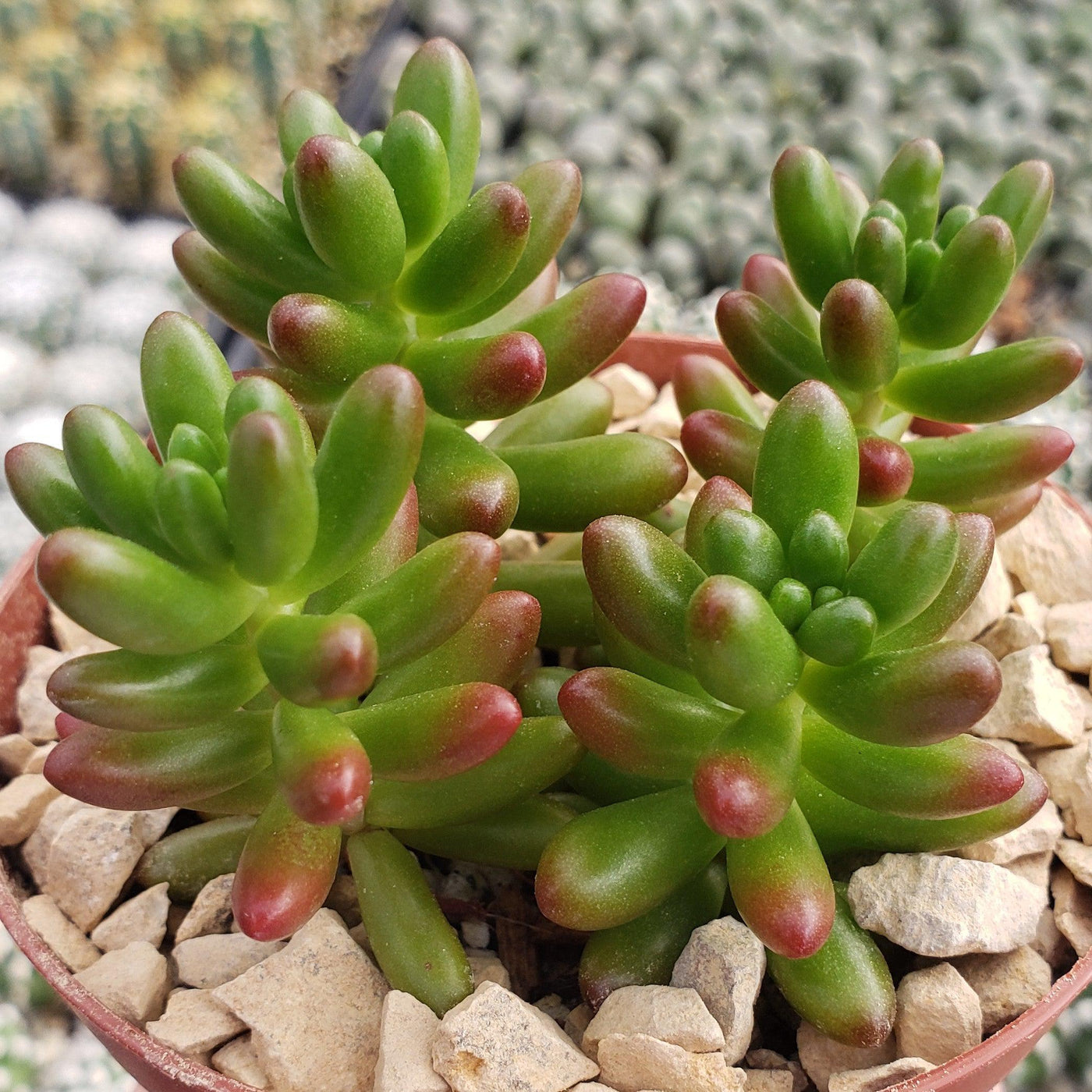
green jelly bean succulent Shop 'Jelly Bean Succulent - Sedum rubrotinctum' Care and Growing GuideIntroducing the Jelly Bean Plant, botanically known as Sedum rubrotinctum, is a charming, low growing succulent admired for its colorful, bead like foliage. Its cascading stems make it an excellent choice for hanging baskets, window boxes, and container arrangements, where its colorful foliage can spill over the edges beautifully. Native to Mexico, this evergreen perennial is commonly called pork and beans or banana cactus due to its plump, jelly bean

Introducing the Jelly Bean Plant, botanically known as Sedum rubrotinctum, is a charming, low-growing succulent admired for its colorful, bead-like foliage. Its cascading stems make it an excellent choice for hanging baskets, window boxes, and container arrangements, where its colorful foliage can spill over the edges beautifully.

Native to Mexico, this evergreen perennial is commonly called pork and beans or banana cactus due to its plump, jelly bean-shaped leaves that give it a playful and unique appearance.

This hybrid jelly bean succulent has small, fleshy leaves that start out green but develop vibrant shades of red, orange, or bronze when exposed to bright sunlight, making it a standout in any succulent collection.

It is often used as a ground cover in rock gardens or featured in decorative containers and dish gardens.

As the plant matures, Sedum rubrotinctum typically reaches about 8 inches tall and up to 24 inches wide, forming a spreading, trailing habit.

Jelly bean succulent flowers are yellow, small, and star-shaped, blooming in clusters at the tips of their stems.

While the blooms are subtle, they provide a delicate contrast to the bold foliage and usually appear in spring to early summer.

Related Product

What truly makes the jelly bean succulent so popular is its combination of low-maintenance care and vibrant color transformation. It is drought-tolerant, easy to grow, and adapts well to both indoor and outdoor environments with proper light. Its ability to change color with sunlight adds dynamic beauty throughout the year.

When and How to Water Your Sedum rubrotinctum Plant

This jelly bean succulent is highly drought-tolerant and prefers drying out between waterings, making it more resilient to underwatering than overwatering.

The Sedum rubrotinctum should be watered once every 1-2 weeks during the growing season, with light soaking and minimal watering once every 3-4 weeks during the dormant season, with very light moisture.

During the active growing season, allow the soil to dry out completely between waterings. This helps prevent overwatering, which can cause the Sedum rubrotinctum roots to rot.

During the dormant season, your jelly bean requires even less water. It's important to remember that succulents like the jelly bean plant are more tolerant of underwatering than overwatering.

Light Requirements - Where to Place Your Jelly Bean Succulent

When growing indoors, you can grow it in the areas where it can receive atleast at least 6 hours of bright, direct light to maintain their vibrant red coloring and compact, healthy growth. 

Place it near a window that receives plenty of sunlight, but make sure to protect your jelly bean plants from direct exposure to intense sunlight, especially during the hottest parts of the day.

A south or west facing window works best, but protect it from harsh midday sun. If natural light is limited, you can use grow lights. 

When growing outdoors, it loves basking in the full sun, so find a location in your garden or patio that receives at least 6 hours of direct sunlight each day. 

When grown in direct sunlight, the color ranges from bright green leaves to red-tipped leaves, with the brightest hues.  However, it's important to note that the jelly bean plant can also tolerate partially shaded areas, especially in regions with intense summer heat. 

Newly purchased jelly bean succulent may burn if placed in full sun right away, so increase exposure gradually.

  1. If the leaves stretch or turn pale, it needs more light.
  2. If they become scorched or develop brown spots, it is getting too much sun.

Optimal Soil & Fertilizer Needs 

The Sedum rubrotinctum favors very airy, sandy soil that drains well, and NPK fertilizers once a year in spring. Planting your Sedum rubrotinctum in ordinary wet soil will result in compacted roots, stunted growth, and, most likely, root rot. Instead, make or buy a well-draining potting mix, or ideally, use our Go to Soil cactus mix blend 1 gal 4 qt cacti succulent dirt compost growing media that contains organic mycorrhizae to promote the development of a strong root system that helps your jelly bean plants and other succulents to thrive. 

A balanced, low-strength fertilizer works best for your Jelly bean succulent plant, ideally with an NPK ratio around 5-10-5, where phosphorus is slightly higher than nitrogen to support healthy growth. Apply fertilizer once in spring at the start of the growing season to give it a gentle boost to support stronger roots and better nutrient absorption. 

Hardiness Zones & More 

In the United States, this jelly bean succulent is mostly an indoor plant, but if you live in southern Florida or Hawaii, then you can cultivate it outdoors in USDA zones 9-11.

If you live in a colder climate, it's best to bring the jelly bean plant indoors or provide some protection during the winter months.

As for humidity, the jelly bean plant can handle a range of humidity levels, from drier to more humid environments. Just ensure that the soil has good drainage to prevent waterlogged conditions. 

How to Grow as a Houseplant 

Your jelly bean succulent grows best indoors in temperatures between 60°F and 75°F. It can tolerate slightly cooler temperatures during the winter months, but it's best to keep it away from drafts or extreme temperature fluctuations. As for humidity, the Sedum rubrotinctum jelly bean plant can handle average indoor humidity levels, so you don't need to worry too much about providing extra humidity. Just make sure the air isn't too dry, especially during the winter when indoor heating can cause dryness. 

Wildlife - Jelly Bean Succulent Flowers Attract the Following Friendly Pollinators 

Jelly Bean Succulent 'Sedum rubrotinctum' can attract friendly pollinators such as bees, butterflies, hummingbirds, and other beneficial insects. These pollinators play a crucial role in the ecosystem by aiding in the reproduction of plants and ensuring biodiversity.

Butterflies
Bees
Hummingbirds
Lady Bugs
Multi Pollinators
Other Birds

According to ASPCA, the Sedum rubrotinctum is mildly toxic to humans or pets if ingested in large amounts. However, it is safe to touch and handle, making it a popular choice for indoor gardens or landscaping due to its vibrant colors and low maintenance requirements.

How to Propagate Your Sedum rubrotinctum Plant 

To propagate your jelly bean plants, stem or leaf cuttings can be used. Both are simple and have a high success rate. Keep the cutting in a spot with bright, indirect light instead of direct sunlight, and give it some time until you begin to see new growth. 

Key Takeaways

  1. Jelly bean succulents are low-maintenance and drought-tolerant. They prefer infrequent watering and can handle dry conditions better than excess moisture, making them beginner-friendly plants.
  2. 'Sedum rubrotinctum' is known as pork and beans succulent or banana cactus, because of their jelly bean-shaped leaves.
  3. These succulents thrive in airy, sandy soil, and keeping roots from sitting in moisture is key to maintaining plant health.
  4. Jelly bean succulents' leaves shift from green to vibrant red or bronze, in bright sunlight.

Final Thoughts

Overall, the jelly bean succulents (Sedum rubrotinctumm) are captivating succulents with their bean-shaped leaves and trailing growth habit. With their vibrant green foliage and occasional bursts of colorful flowers, they add a touch of whimsy to any space. A succulent tends to live for many years and grows slowly. Plant them in the spring after the weather warms up. Propagating these succulents is relatively easy, whether through stem cuttings or fallen leaves. Jelly bean succulents are a delightful addition to any succulent collection, bringing charm and beauty to both indoor and outdoor settings. If you're looking for a unique and low-maintenance plant, the jelly bean succulent is definitely worth considering!

Don't miss out on this opportunity to add something truly exceptional to your garden. Order your very own jelly bean Sedum rubrotinctum today!
Shipping Notes
  • Free Standard Shipping on $100+ Orders to the USA.
  • Except Preorder products are shipped in 48 hours.
  • Delivery to the USA:
  1. Standard Shipping : 3-10 business days
  • If time is of the essence, please consider selecting expedited delivery for faster service.
Exchange/Return Notes
  • We offer a 30-day return/exchange service after receiving.
  • Final sale items are not eligible for returns or exchanges.
  • To process your return/exchange, please contact us at [email protected]
  • Please click here for more details>>> Return & Exchange Policy
SKU: 36750142438

Discover Niche Categories That Outsell green jelly bean succulent

Top-Converting Item to Boost Your Average Order

4.3 ★★★★★
Based on 338 reviews
Sort
Highest Rating
Newest First
Oldest First
Product Reviews
W
Verified Purchase
William H Vickers
Waukegan, US
★★★★★ 5
The Spirit Realm is Real!
Format: Kindle
Great little book with a big powerful message! If you are seeing things in the spirit that others don't see and you're not sure what to do about it, this book is for you!
WAS THIS REVIEW HELPFUL?YesReportShare
Reviewed in the United States on May 22, 2025
S
Verified Purchase
S.B.
Natrona Heights, US
★★★★★ 5
Great, easy to understand explanations
Format: Kindle
I definitely needed this! I have been enduring a long period of spiritual attacks in the natural and physical realms. It has helped me to better understand my calling, even though I have been serving God as a spirit filled and spirit baptized follower of Yeshua.
WAS THIS REVIEW HELPFUL?YesReportShare
Reviewed in the United States on February 26, 2025
T
Verified Purchase
Trader Dave
Louisville, US
★★★★★ 5
Easy to read. Line spacing is just right! Thank you!
Format: Paperback
Michael Van Vlymen delivers the lived from experience truth once again! Michael is down to earth and matter of fact as he writes. He is heavenly minded every day! I've grown more in love with Jesus because of his testimony of heavenly realms operating on the earthly realm. My eyes have been opened much much more as I listen and read Mikes well illustrated books and videos!
WAS THIS REVIEW HELPFUL?YesReportShare
Reviewed in the United States on February 24, 2025
O
Verified Purchase
Online shopper
Cuba, US
★★★★★ 5
Challenge Accepted
Format: Kindle
I liked the book. It challenged my position of focusing on the light and ignoring the darkness. It challenges me to desire the whole experience of spiritual awareness and sight and to become adept in living as a watchman.
WAS THIS REVIEW HELPFUL?YesReportShare
Reviewed in the United States on March 11, 2025
T
Verified Purchase
Tim Chaffey
Natrona Heights, US
★★★★★ 5
Outstanding, compelling, and thorough work on the historicity or non-historicity of the Resurrection of Jesus
Format: Paperback
I had been looking forward to reading this book since the first time I heard about it. I was sitting in Dr. Gary Habermas' class on miracles and he told us about Mike Licona, who was currently working on his dissertation on the Resurrection. Although it was published in 2010, I finally had the opportunity to read it over the past few months. At over 700 pages, including an extensive bibliography and over 2,000 footnotes, this book is not a light read by any stretch of the imagination. As the subtitle states, this is a book dealing with historiography. Readers looking for a deep theological treatment on the Resurrection of Christ may want to look elsewhere since Licona's focus here is not theology, but history (although there is still a good deal of theology). Using methodological principles agreed upon by a vast number of historians from a variety of religious and philosophical backgrounds, he sets out to determine whether or not the historian "is warranted in regarding Jesus' resurrection as an event that occurred in the past" (p. 610). Surprisingly, the book consists of only five chapters and one appendix, so each chapter averages more than 100 pages in length. Also, the second half of the book contains a significant amount of Greek, giving me a good opportunity to brush up on that. If you can't read Greek, don't worry, Dr. Licona provides an English translation throughout. The first section deals with a significant number of preliminary considerations. There is an excellent critique of the skeptical postmodern view of history and a complete dismantling of the beliefs of Jesus "mythers" (those who claim Jesus never existed). There's also a good discussion on horizons (the presuppositions and biases we all have). While total neutrality may not be possible, Licona gives several principles historians should implement to help them transcend their horizon. Finally, he provides an honest discussion of his own biases so that readers are well aware of where he is coming from. The second chapter focuses on whether or not miracles fall within the purview of the historian. Licona addresses the popular objections of David Hume and Bart Ehrman, as well as McCullagh, Meier, Wedderburn, and Dunn. Many skeptics simply have an a priori objection to miracles, so they aren't willing to even consider the possibility that historical evidence for a miracle may exist. There's an interesting discussion on the burden of proof as it relates to the historicity of miracle claims. I thought the following quote summarized the nature of evidence when it comes to miracle claims: "It is the responsibility of the historian to consider what the evidence would look like if she were not wearing her metaphysical bias like a pair of sunglasses that shade the world. It is not the responsibility of the evidence to shine so brightly that they render such glasses ineffectual." (p. 196) With all the preliminary matters out of the way, Dr. Licona gets down to the business of doing history. Chapter three examines the historical sources pertaining to Christ's Resurrection. Many Christians may object to the methodology employed in this chapter since he does not automatically accept every biblical passage on the subject as evidence, but bear in mind that Licona is doing his best to transcend his own Christian horizon to be as neutral as possible. He discusses over two dozen early sources and rates them as "unlikely, possible-minus, possible, possible-plus, highly probable, indeterminate [or] not useful" (p. 201). The fourth chapter uncovers the historical bedrock pertaining to the fate of Jesus. This approach follows on the heels of the exhaustive work of Dr. Habermas who, since 1975, has kept track of over 3,400 academic works from scholars of various stripes on the Resurrection in English, German, and French. From this research, Dr. Habermas has shown that there are 12 facts accepted by the vast majority of scholars. He has reduced this to six best attested details in what he calls the "minimal facts" approach. Each of these facts are discussed, but Dr. Licona narrows this down to three facts that nearly all scholars agree upon: 1) Jesus died by crucifixion, 2) the disciples had experiences that led them to believe and proclaim that Jesus had risen from the dead, and 3) Paul converted to Christianity after experiencing what he believed to be a post-Resurrection appearance of Jesus. There's also a lengthy discussion on what "resurrection" meant to Jewish and Christian audiences in the first century. The information contained in this chapter is often completely ignored by agnostics, atheists, Muslims, and others who do not want to even consider the Resurrection as a possibility. I have had many discussions with skeptics who display naivete when they claim that there is no evidence to support the claim that Jesus rose from the dead. It's one thing to disbelieve in the event, but it's an entirely different thing to completely ignore or to willingly remain ignorant of the historical bedrock pertaining to the fate of Jesus. The fifth and final chapter of the book examines six different hypotheses that attempt to explain what happened to Jesus after being crucified. Along with the traditional Christian understanding of the Resurrection, the views promoted by Vermes, Goulder, Ludemann, Crossen, and Craffert are weighed in terms of their explanatory scope, explanatory power, plausibility, the amount of ad hoc elements, and illumination for solving problems associated with the subject. An appendix also examines Dale Allison's work on the Resurrection according to the same criteria. The traditional Resurrection hypothesis is the only view that fulfills all five criteria, and it outdistances the other views by a wide margin. Critics can claim that Licona merely concluded what he hoped to prove, but they must be able to point out flaws in his methodology, since his conclusion most certainly follows from the data when historiographical principles are applied. My biggest concern with the book is found in the fifth chapter. While discussing the strange events described in Matthew 27:51-53, Licona suggested that the passage was not describing historical events but employing apocalyptic language to show that a significant person had died. Such descriptions were not uncommon in the ancient world when describing the death of important people. This comment has set off a wave of criticism from conservative Christian scholars like Norman Geisler and Al Mohler. I disagree with Licona's statement and share some of the same concerns as Geisler and Mohler. But when I consider the context and methodology being used in the book, I don't find it to be quite as grievous an error as some have claimed. Skeptics will undoubtedly continue to dismiss the Resurrection of Christ, but they must deal with the research in this book or they simply are not interacting with the latest scholarship. Dr. Licona's work raises the bar when it comes to the most important subject we could ever study: the Resurrection of Jesus Christ. I highly recommend it for anyone interested in this subject who is up to the task of reading an academic work. I have studied the subject for years, but I still learned a lot and will treasure this book as an extremely valuable resource. Even though I disagree with his take on Matt. 27:51-53, I still need to give the book five stars since I don't need to agree with the author on every point for me to give a positive review and recognize the book's worth.
WAS THIS REVIEW HELPFUL?YesReportShare
Reviewed in the United States on December 30, 2012

recommand products